Organization Highlight: LiKEN Knowledge Appalachian Heirs’ Property Center
About LiKEN Knowledge
Livelihoods Knowledge Exchange Network (LiKEN Knowledge) is a non-profit organization established in 2015 with a main office located in Winchester, Kentucky. The decade-old organization serves as a bridge, or ‘link-tank,’ in collaborations between scholars, communities, and resource providers. Its mission is to nurture locally based livelihoods, build trustworthy cross-sectoral collaborations, and catalyze the coproduction of knowledge. To this effect, LiKEN Knowledge conducts rigorous scholarly research and develops direct technical assistance programming in collaboration with communities and constituencies affected by environmental injustice and boom and bust economies – primarily in Central Appalachia, Indigenous communities, and the U.S. South. Currently, their work focuses on building programming across five main issues: land ownership, forest farming, disaster resilience, cultural narratives, and water quality and affordability.
A core principle of LiKEN Knowledge’s work is that people understand their own places, environments, and communities in ways that are essential to good public policy and good science. Thus, the organization is constantly striving to create programming that is rooted in the knowledge and needs of local people. LiKEN Knowledge ensures that its programming aligns with local realities by investing in a brick-and-mortar presence and developing Community Engagement Coordinators, leaders with deep roots in the communities they serve. In 2026, LiKEN Knowledge operates nine brick-and-mortar locations across eastern Kentucky and southern West Virginia, each of which serve as a hub for Community Engagement Coordinators and local residents.
The Appalachian Heirs’ Property Center
LiKEN Knowledge first encountered heirs’ property in 2019 while conducting interviews with farmers in Kentucky as part of a collaborative research project with the US Department of Agriculture on agricultural credit access barriers (Taylor et al., 2022). At the time, heirs’ property was garnering national attention, largely in response to the work of organizations like the Center for Heirs’ Property and the passage of the Uniform Partition of Heirs’ Property Act in several states. Researchers correctly identified the U.S. South and Central Appalachia as two hotspots of heirs’ property (Dobbs and Gaither, 2023). However, families in Central Appalachia were not being served by any legal services or technical assistance organizations that had the capacity to resolve title to heirs’ property.
Access to affordable and trusted legal services is a persistent problem in Central Appalachia. For many in the region who have heard family stories about losing land to attorneys employed by extractive industries, attorneys are to be avoided at all costs. As a product of intestate succession (death without a valid and probated Last Will & Testament), heirs’ property itself is a testament to the dearth of accessible legal services. The long history of distrust and unaffordability – paired with chronic underfunding for legal aid in the region – has left “cash rich, land poor” heirs’ property owners with little opportunity to receive the long-term assistance they need to resolve title issues and preserve family ownership of their land. To address this gap in resources, services, and trust, LiKEN Knowledge collaborated with the Center for Heirs’ Property to create the Appalachian Heirs’ Property Center (AHPC), a free legal and land-use technical assistance program for people who own heirs’ property in eastern Kentucky and southern West Virginia. The AHPC’s legal technical assistance seeks to both prevent and resolve heirs’ property through estate planning and title clearing services. The land-use technical assistance seeks to encourage the development of sustainable livelihoods from the land, with a focus on promoting the adoption of agroforestry practices suited to the mixed-mesophytic forests of Central Appalachia.
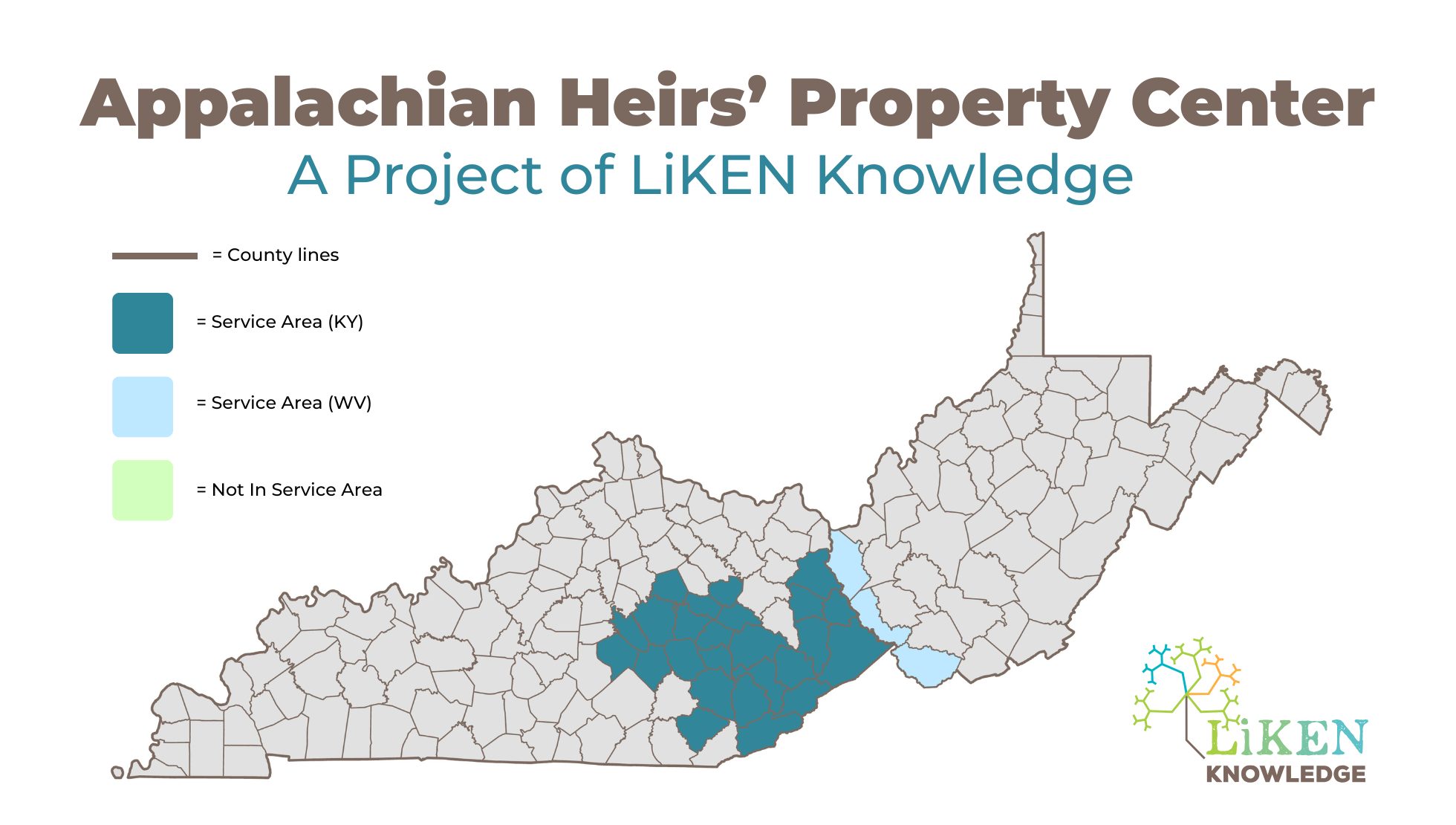
Modeling cross-sectoral collaboration, the AHPC is composed of community organizers, attorneys, paralegals, and natural resource professionals who work in tandem to assist heirs’ property owners. The AHPC works with heirs’ property owners to draft a “title clearing plan” that lays out the process for acquiring a clear title to their heirs’ property. Plans are drafted on a case-by-case basis but typically, the AHPC can assist families as they draft their family tree, collect necessary documents (i.e. wills, deeds, affidavits of descent, etc.), conduct title searches & identify liens, coordinate family meetings, and create an LLC or Trust while also drafting the necessary legal documents for title consolidation. For legal document drafting and consultations, LiKEN Knowledge closely collaborates with the Lexington-based law firm Joe F. Childers & Associates. While LiKEN Knowledge provides long-term technical assistance to people who have already inherited an interest in heirs’ property, they also seek to prevent heirs’ property formation by promoting and creating opportunities for estate planning and organizing. In the spring, summer, and fall, LiKEN Knowledge organizes aLast Will & Testament Free Clinic in a different Central Appalachian county each month. The Will Clinics give participants the chance to sit down with a lawyer and write a will at absolutely no cost. During every Will Clinic, attendees also have the opportunity to speak one-on-one with a staff member about heirs’ property. Between March 2024 and November 2025, LiKEN Knowledge organized 15 Last Will & Testament Free Clinics across 11 counties, during which volunteer attorneys drafted 244 wills. At a market rate of $300 per simple will, the Will Clinics have cumulatively delivered $36,600 worth of estate planning services directly to residents in Central Appalachia at no cost to them.

Research Rooted in Local Knowledge
Concurrently with their title clearing, education, and land-use services, LiKEN Knowledge also conducts rigorous mixed-methods research and produces educational materials. The organization conducts this research to inform their own programming but also to educate resource providers, advocacy organizations, state policymakers, and federal agencies about the lived experiences of heirs’ property owners and how tangled title impacts Appalachia at the community level. The organization asserts that updating policy on heirs’ property and related issues like property taxes and property rights has the potential to make meaningful change at a large scale. But, the efficacy of heirs’ property policy depends on policymakers’ understanding of local dynamics and how they might differ from other states that have implemented policies related to heirs’ property. To clarify the dynamics of heirs’ property loss in Kentucky relative to similarly high heirs’ property-concentrated communities in the U.S. South, LiKEN Knowledge collaborated with the US Forest Service to produce a research article titled “Examining the Efficacy of the Uniform Partition of Heirs’ Property Act in Georgia, Alabama, and Kentucky.” This report, along with other resources produced by LiKEN Knowledge, can be downloaded on the Resource Directory page on Heirs’ Property Central.
References:
Betsy Taylor, Carson Benn, Karen Rignall, Deborah Thompson, James Embry, Madison Mooney, Simona Perry. 2022. Where Credit is Due: Examining USDA Finance, the Farm Credit System, and Barriers to Local Wealth and Sustainability. Report published by LiKEN.
Betsy Taylor, Cassandra Johnson Gaither, Megan White, Simona L. Perry, Victoria Hiten, Rebecca Dobbs, 2021. Examining the Efficacy of the Uniform Partition of Heirs’ Property Act in Georgia, Alabama, and Kentucky: A Proof of Concept Investigation. Report published by LiKEN.
G. Rebecca Dobbs and Cassandra Johnson Gaither. 2023. How Much Heirs’ Property Is There? Using LightBox Data to Estimate Heirs’ Property Extent in the U.S. Journal of Rural Social Science.