2025 National Rural Housing Conference – Workshop 2
Sustaining Homeownership Through Collective Generational Land Practices Workshop – Pt. 2
The National Rural Housing Conference took place during the week of November 2, 2025, in Washington, DC. During the conference, the Heirs’ Property forum convened practitioners, researchers, policymakers, community leaders, and funders to explore the multidimensional challenges surrounding heirs’ property.
Across all sessions, the forum revealed that heirs’ property is a multidimensional, intergenerational, socio-economic, cultural, and infrastructural challenge. Addressing requires cross-sector ecosystems, legal, financial, design, philanthropic, governmental, community-led, that can meet families where they are, honor their histories, and create durable structures for long-term stability.
Building on this shared understanding, the forum was organized as a pre-conference symposium featuring a series of panels, followed by two workshops during the conference week that examined these themes in greater depth. This article recaps the key takeaways from the second workshop session. This article is part of an ongoing conference series. Want to learn more? Explore the full series below.
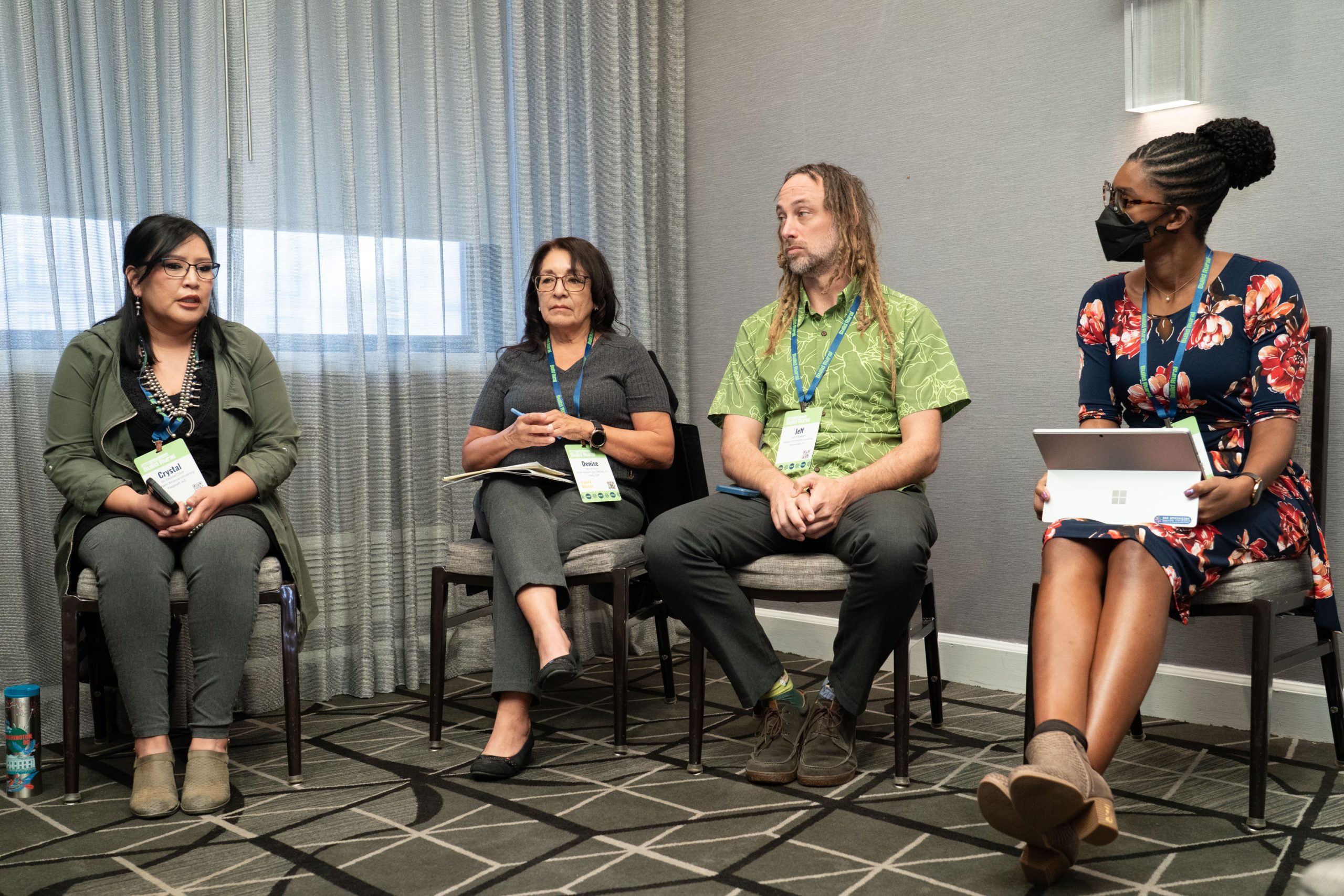
Sustaining Homeownership Through Collective Generational Land Practices
Panelists:
- Dr. Crystal Carr Cook, Research Associate, Northern Arizona University
- Jeff Gilbreath, Executive Director, Hawaii Community Lending
- Denise Zuni, Owner and Attorney, Sh’eh Wheef Law Offices
- Natasha Moodie, Senior Research Associate, Housing Assistance Council
Overview
Heirs’ Workshop 2 expanded from cultural practices into the structural, financial, and governance tools needed to support collective landholding. The panel examined cooperative housing, resident-owned communities, lending barriers, and cross-disciplinary examples that illustrate how collective ownership can be stabilized.
Session Recap
1. Examples of Resident-Owned and Cooperative Communities
Panelists described communities that avoid displacement by adopting cooperative or resident-owned models: “Some communities torn down and replaced; some turned into resident-owned communities and stabilized.” These examples demonstrate that collective landownership can be formalized, governed, and financially viable.
2. Lending Structures Do Not Support Family-Level Ownership
One of the most significant barriers discussed was that lending institutions are designed for individual borrowers: “Loans are given to individuals; family-level lending is difficult to work through.” Families seeking to collectively manage or improve property often cannot meet underwriting criteria because:
- Credit scoring is individual
- Fractional ownership complicates collateral
- Many heirs are land-rich but cash-poor
- Cooperative models lack lender familiarity
3. Rural Studio and HAC as Models of Cross-Disciplinary Practice
Institutions like Rural Studio and the Housing Assistance Council (HAC) integrate design, community development, and policy. “Rural design; HAC is more inclusive of community and demographic types.” Their work shows that sustainable collective landholding requires contributions from architects, planners, lawyers, builders, and policy practitioners.
4. Governance Tools for Collective Land
Expanding on Heirs Session 1, this session highlighted the need for:
- Family governance agreements
- Cooperative bylaws
- Community land trusts
- Resident-owned community structures
- Conflict resolution and mediation frameworks
Families require durable, long-term governance mechanisms.
5. Stabilization Without Forced Individualization
The discussion emphasized that stabilizing land tenure does not require breaking up collective ownership or forcing individual title solutions. Cooperative and family governance models provide paths to stability while honoring how families actually manage land.
Key Takeaways
- Cooperative and resident-owned community models are viable and scalable.
- Traditional lending systems do not support collective or family-level ownership.
- Practical tools needed include cooperative agreements, family LLCs, and community land trusts.
- Cross-disciplinary approaches (Rural Studio, HAC) advance sustainability.
- Stabilization does not require individual ownership; collective models must be supported.
Stay tuned, in the coming weeks, we will be sharing more conference highlights.
Compiled and written by Odia Kaba, Research Fellow