


Property and land retention affect generational wealth
Owning property has long been a way to build wealth. People buy homes to create stability and gain equity over time. But this path has not been equal: systemic exclusion has fueled the racial wealth gap.For generations, Native American and Black families lost land through policies that favored individual property ownership over traditional shared land practices. Another impact of inequitable access to resources has led to a higher prevalence of title issues in persistent poverty counties and communities of color, leading to increased vulnerabilities for homeowners and communities. One common form of title issue is heirs’ property, which refers to land with multiple living owners but no legally recognized title in their name.
Heirs’ property can be created when multiple descendants inherit the property without a formally recorded transfer of ownership
Heirs’ property happens when land or a home is passed down without a clear transfer of ownership. This often results in multiple people owning the property together, called “cotenants.” It can come about in a few ways:
- When a property owner dies without a will, ownership is split among descendants.
- Even with a will, if heirs don’t complete the probate process to formally transfer ownership, the property remains heirs’ property.
Over time, as heirs pass away, the number of cotenants grows across generations.
Because there’s no clear title, heirs’ property is sometimes called tenancy in common, and the heirs are known as cotenants.

Heirs’ property and collective landownership practices developed over time in the early United States
When a landowner died without a will or estate plan, the property defaulted to tenancy in common, a system that allowed many heirs to share ownership and keep access to the land. This was different from European property laws, where landownership typically ended after one generation.
Following the Civil War, previously enslaved Black Americans were kept from accessing sustainable landownership. If Black freedmen were able to purchase land, exclusionary legal systems prevented them from formally passing their land to their children, creating heirs’ property.
In the mid-19th century, the United States government imposed singular landownership practices on Native Tribes who had historically and collectively stewarded land throughout North America. Large areas of land occupied by Native Nations were subdivided by the federal government through the General Allotment Act of 1887, or the Dawes Act. Land allotments were assigned to individual members of Tribes, but any “leftover” parcels of land were allowed to be purchased by westward-moving settlers. Similar to property, when a Native landowner died, their allotment was passed on to their descendants collectively.
National estimates of the total value of properties held as heirs’ property range from $32 billion to $41 billion.

Research on heirs’ property has been ongoing for over 45 years.
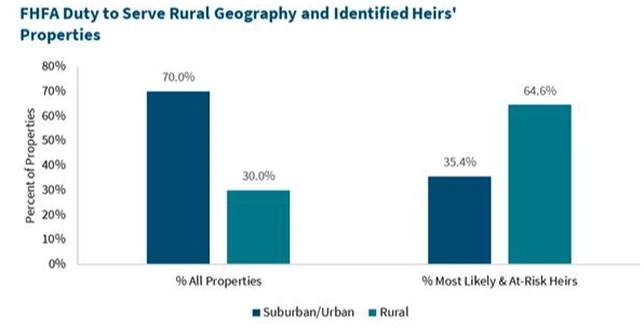
Dobbs and Johnson Gaither published the first national estimate of heirs’ property in 2023, identifying 444,172 heirs’ property parcels across the country with a total combined worth of $41.3 billion. The Housing Assistance Council, in collaboration with Fannie Mae, identified $32 billion worth of residential heirs’ property made inaccessible due to unclear title across 44 states and the District of Columbia. This study also estimated that approximately two-thirds of the identified residential heirs’ properties are located in rural areas.
Localized heirs’ property parcel estimates range from 0.03 percent to 9.6 percent. Due to data availability and uniformity challenges, these figures represent the minimum prevalence and estimates of wealth made inaccessible due to title issues.
Heirs’ property and communal landownership
Many heirs’ properties are unintentionally created because of a lack of access to or mistrust of the legal system. However, families around the United States have adapted to living on heirs’ property as units, collectively managing their land as a shared resource.
For some families, extended-family households or settlements are a way they can relieve economic pressures. By combining multiple family units on one property or in one household, families can share physical, social, and financial resources.
Some landowners prefer to hold land communally. In the rural South, it is common to see families using one parcel of land for several households, sharing responsibility and use of the property. This allows the family to keep their property as a place for any family member to come back to. On lands held by Native Nations, tradition and culture prioritize collective stewardship of land, and individual ownership is not seen as necessary. Together, Tribal members care for and use the land as they need.
While heirs’ property ownership is often presented as a mistake or an issue to be resolved, it is a historically relevant and legally legitimate way to hold property, and can benefit the needs and preferences of landowners today.
Key takeaways
Heirs’ property is a form of landownership that allocates property rights to multiple “cotenants,” or heirs, who all effectively own the property together.
While heirs’ property is a legal way to hold land, it is not fully recognized by the current financial and housing systems, which can cause problems for heirs. Read more about obstacles faced by heirs’ property owners.
Heirs’ property is a common form of landownership, especially in rural America. It is often created unintentionally, but it may create risks for property owners.
Heirs’ property can reduce access to generational and community wealth if heirs are not present or aware of the property, or cannot utilize their property to secure financial products or economic mobility.
Native Nations have practiced collective stewardship of land since long before the United States began subdividing parcels for individual ownership. Today, many Tribal members still prefer to think of land as a shared resource.